Showing posts with label History. Show all posts

Wednesday, October 19, 2016

The funny side of the 1957 Dublin Zonal


Today I want to share this very humorous view of the 1957 Dublin Zonal. I am normally reluctant to post stuff unless I know all the background information - but I am posting hoping that my more learned readers can provide more information. 


Chess Masters are Human

Mlle Pour-quoi Pas

Several years ago I asked a friend of mine what chess was all about. He answered vaguely without raising his eyes from the board, ‘The object of the game is to get a mate’. Well, what do you know! Since that had been my professed object from the age of sixteen I got right down to the game. We-ell, lets be honest – which of us is in it for the love of it?
I joined a club, learnt the moves and looked about me. After a while I realized there was one thing chess-players had in common – there were all different- if you know what I mean!! They say them-selves they are just tempermental. I’d say 25 per cent temper , the rest mental! I soon discovered there were degrees of chessmanship – rabbit, player, master and grandmaster – and I looked forward to any tournament that would bring some of the masters across so I could get a straight look at them. After all, if the rabbits and players were a crazy, mixed-up gang surely one could expect at least extreme individuality if not a little gentle lunacy from the masters. You can’t be all that brainy without being a little soft somewhere!
The first masters to come here were Robert Wade and John Fuller. I watched them curiously at the opening of the tournament as they stood, polite but aloof, discussing ‘variations’ with ‘patzers’, and signed autographs. At the close of the evening we all adjourned to the school kitchen for the inevitable Irish ‘last cup of tea’. The masters sipped theirs surrounded by admiring crowds whilst I, mentally wishing them all to Jericho, tackled a mountain of dishes. Suddenly Wade edged his way out of the crowd and, without a word, rolled up his sleeves and tucked into the washing!!
Since that auspicious beginning I have met many of the masters and discovered in each of them a type of dual personality that is absolutely fascinating. Over-the-board they are intellectual giants, serious, calculating, fighting brain to brain every inch of the way. Away from the game there are like children, delightfully natural and ingenuous, kindly and gentle, but above all, intensely human.
This year’s Zonal Tournament gave me a further opportunity to observe the masters in all their moods. When I went down first, I wandered over to the Czechoslovak contingent, obeying Rule No. 1 for Rabbits – ‘Never miss a Czech – it might be mate!’ There I found Ludek Pachman with unaffected simplicity telling some hair-raising jokes in beautiful, broken English, whilst his second, Georg Fichtl, beamed at him approvingly – without understanding a word!
Earlier in the day Fichtl, his head in a chess cloud, jay-walked across Dublin’s main thoroughfare causing a minor traffic jam. The guard on point duty collared him and produced the inevitable notebook and pencil. Fichtl just shrugged his shoulders indifferently and said, ‘I no speak English. I Czechoslovak chess-player’. The guard looked at him with a new respect and, holding up the traffic, ushered him majestically across.
Another master with language difficulties was Pal Benko. Despite the fact that he spoke neither English nor French and only had a smattering of German he became tremendously popular. Everyone liked the big Hungarian who, ‘speaks no English’, and that shortly became the only English phrase he did know. One afternoon when he went to post a letter, the tournament controller, Joe Keenan, brought him to the wrong entrance of the post office. When an official came to direct them Benko tapped him on the shoulder and, pointing to Keenan, said ‘He speaks no English!’
Altogether that tournament left me some great memories. Of wonderful game of chess?? Well, no, they leave me as bewildered as a duck in thunder. But of little things. Of Lothar Schmid, his back to the hotel authorities contentedly munching a leg of chicken obtained no one knows how; of Francisco Perez falling asleep in the dress circle at the Opera; of Kurt Dreyer peacefully sucking his silver-stemmed pipe and chuckling gently at the ‘patzer’ who asked how it was that he, coming from South Africa, spoke such good German; and Stenborg proudly displaying photos of his beautiful wife and children; of Doodah playing Irish dance music; of Giustolisi, the sad-eyed Italian, who had there fiancées in Rome and wanted one in Ireland; of Gligoric tying himself in knots to progressive jazz; of Conrady playing table tennis like a ballet dancer; of Alexander fussing about the lack of formality of the tournament, then shrugging his shoulders and saying, ‘Sure I’m Irish myself!’; of Durao gazing dismally into a mirror and commenting rather sadly, ‘You know every man in Portugal is more handsome than I’ and of the inimitable Pachman laughing so much over a game of poker that he rolled fully-dressed into the sea.
Though I’ve never managed to get a mate, live or otherwise, it has been wonderful to make the acquaintanceship of these kings of the board, these charming chess nuts who combine genius with simplicity, and brilliance with naivety to make such delightful and unusual companions. And who know, some day perhaps, I may be able to regard them all as chess mates?


‘The Chess player's Bedside Book’, Ray Keene, Ray Edwards (eds) Batsford, 1975.

Wednesday, November 4, 2015

A look back at club chess in Ireland.

While doing some research recently I came across the following article in the Duhallow Magaazine in the local history section of Cork library.  It is rather vague on specific dates but is still of some interest. John Reid was Irish Champion in 1961 and shared the title in 1962. I thought I'd share it and hope others will also find it of interest.

World Championship Chess
in Coolclough
DENNIS DUGGAN

Coolclough is a townland approximately five miles south west of Kanturk, in the parish of Dromtariffe, in the diocese of Kerry, in the County of Cork.
In Irish the name of the townland is Cul Cloch; Cul or Cuil meaning a space enclosed by the confluence of two rivers, or a bend in the river; and Cloch meaning 'stones" - very likely the stones used for crossing the river - often referred to as 'stepping stones'.
In the Irish language, that part of the river was known as - 'Ath na gGorp' - in English - the 'Ford of the Corpses', presumably from the difficulty encountered in taking corpses across the river over the aforementioned stepping stones on the way to interment in nearby Dromtariffe Cemetery. That Southern part of Coolclough townland is still referred to as 'The Ford'.
In the Cenus of 1841, four years prior to the great famine, Coolclough had a population of 550, and being the greatest centre of population in the area, it gave its name to the group of townlands known as the Electoral Division of Coolclough.
At that time, Coolclough could boast of three shops, two public houses, a school and a Catholic Church, and one of the three football clubs whose members played under a set of rules known as 'Rough and Tumble', prior to the foundation of the Gaelic Athletic Association, in 1884. The other football clubs in Duhallow were Coiseim and Millstreet.
In the year 1949, Andrew Forest, a Coolclough farmer and author of a book on his own life and times entitled - 'The Story Could be Worse', came into possession of a chess set and board. Andrew had no knowledge of the game. He mentioned the problem to his friend, Seamus Walsh, who luckily knew an Englishman, named Campbell, who could play the game. Soon Andrew Forest, Jerome Murphy, and Con Fitzgerald had learned the moves; and games were, usually, played in the home of Con Fitzpatrick. Con's brother-in-law, Dan O'Shea, introduced the game to a member of the Garda Siochana, John Reid, who had time on his hands as he recuperated after an accident. John Reid found others who could play, and a chess club was formed.
The proceeds of a card drive, £40, helped to defray the initial expenses. A comfortable room, with a coal fire laid on, was provided by Sheila Nunan, at the Ford, Coolclough.
To raise above the mundane, the new chess club was named - 'L'Avenir', a French word meaning 'Future', chess practice was arranged for 8 p.m. to midnight, twice weekly, and L'Avenir was ushered into the present.
L'Avenir was entered for all competitions. A local competition commenced, and a chess team of ten players was entered in a postal chess competition. Four players, John Reid, Seamus Walsh, Andrew Forest, and Karl Holland were entered for the Plunket Cup. This Senior Competition was too ambitious but the players learned quickly from their defeat, and enjoyed the experience.
In the first year in Postal Chess, the club came fourth in Division Four. In the second year, the club won Division 3 and brought the J.J. O'Hanlon Cup to Ireland. Next year, the club won Division Two, and the Derbyshire Trophy, and qualified for Division One. Coventry won the Division with a score of 26.5 points. L'Avenir came in second, with a score of 26 points.
In the Golden Knights Tournament, L'Avenir defeated Milford; Cork C.Y.M.S. defeated Kilfinane, and in the final, with victories for Reid and draws for Denis and Con Duggan, and a win for O'Keefe on the fifth board, all depended on L'Avenir's Eddie Thornton on the sixth board. As the sixth was not completed on the deadline, the position was sent to Sutton Coldfield in England for adjudication; and back came the news that Thornton had won. So L'Avenir had won the Golden Knight's Tournament.
L'Avenir again had four players in the Senior Plunket Cup; they were John Reid, Denis Duggan, Con Duggan, and Bill O'Keefe. John Reid drew with E.N. Mulcahy, Irish Champion, and then had a string of victories, while hoping that someone would oblige and defeat Mulcahy. O'Leary of Cork C.Y.M.S. did the needful. O'Leary lost to Con Duggan, so Reid had won the Plunket Cup, and was champion of Cork.
The same L'Avenir team of Reid, Denis Duggan, Con Duggan, and William O'Keefe competed for the Tostal Trophy, and with 16 teams competing. easily romped into the last four, and with victories for Denis Duggan over Dr. Hutch, and wins also for W. O'Keefe, Con Duggan, and Reid, the Coolclough team won the final against Mitchelstown. John Reid won the Irish Chess Championship at the second attempt, and both he and E.N. Mulcahy, the Irish Champion of the proceeding year, played chess for Ireland in the Olympics.
Con Duggan entered the Premier Reserves, an event run in conjunction with the Irish championship, and with 10 wins and 2 draws, won the event. Con also played in the Irish Championship and finished half way up the table. Bill O'Keefe also playyed and lost to the grand old man of Irish Chess, J.J. O'Hanlon, then in his 80th year.
When Leonard Barden won the British Championship, he came to Ireland and gave successive displays in Dublin, Cork and Killfinane. In Killfinane, he had 27 wins and 2 draws, but lost once to Denis Duggan of L'Avenir. In Cork, he had 29 wins and one draw, but lost to H. Deane-Roe.
Then came the great game against Killfinane in Coolclough. With five games played, the teams were level, and Eddie Thornton was winning well in the sixth game, but as celebrations were about to commence, the awful news came that Eddie had blundered and the game was lost. With song and dance and recitation until day-break, Kilfinnane showed all and sundry how to celebrate.
L'Avenir came second again in the Postal Chess of that year. The Line-up was: 1. John Reid, 2. Dennis Duggan, 3. Con Duggan, 4. F. Brennan, 5. W. O'Keefe, 6. Eddie Thorton and James Barrett could always be relied on if anyone were missing. John Reid was promoted Sergeant, and having married Marion Deady of Banteer, was transferred to Adare. Con Duggan was called to Garda Training School in Templemore. Bill O'Keefe retired to take up the more relaxing game of Bridge, and chess languished in Coolclough.
Andrew Forest spearheaded an attempt to revive the club in 1960. New yound members such as Jeremiah and Michael John Neville, Jerry and Ronnie O'Leary, Denis and Seamus Moynihan, Denis and John O'Donoghue, Tommy Lande and Peter and Brendan Tancred were enlisted. A team was entered for the Junior Championship, and had two victories over Crescent College Limerick; but the effort soon disintegrated, and the glories of L'Avenir were in the Past.

Duhallow Magazine
Vol. XIII 2003.

Wednesday, September 18, 2013

Mr. Rynd the Arch Deceiver?


I am sorry to say that after further research I have stumbled upon an article by John Roycroft in EG143 that sheds serious doubt on the honesty of our Mr. Porterfield Rynd. It appears Mr. Rynd in one of his columns laid claim to having played the variation that later became famous as the Saavedra position.

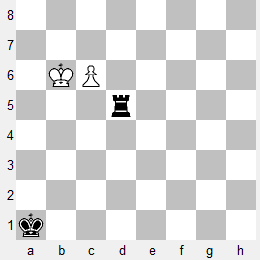
This is the famous position. It was initially published in an 1895 chess column with the solution

1.c7 Rd6+ 2.Kb5 Rd5+ 3.Kb4 Rd4+ 4.Kb3 Rd3+ 5.Kc2 Rd4, followed by 6.c8=Q Rc4+ 7.Qxc4 stalemate.


Rev. Fernando Saavedra (1849-1922), a sharp-eyed reader of the column, pointed out that 6.c8=R Ra4 7.Kb3 wins, and the Saavedra position was born.

Mr. Rynd claimed that while the Rev. Saavedra was visiting Dublin he had seen his play and therefore Mr. Rynd should get credit for the discovery.

Mr. Roycroft being a fair historian states that Mr. Rynd's honesty should not be doubted unless further examples of his claims can be found. I cannot prove as yet that the last posts position was constructed however, it is a possibility and therefore does slightly tarnish the game. Mr. Roycroft also states that Mr. Rynd claimed to have won a match against Amos Burn although no prove of same can be found.

In all fairness there is also verifiable proof that Mr. Rynd was quite a strong player, winning the 1865 Irish Championship and with victories over W.H. Pollock, etc. But I think Mr. Roycrofts findings are spot on and detract from his other achievements.

Mr. Porterfield Rynd was quite opinionated and wasn't shy of controversy. As this clipping from the "Otago Witness" of 8th Sept 1892 shows.


Despite it all a very interesting character and one who will keep historians on their toes.

Monday, September 2, 2013

Forgotten Gem!

While doing some research recently I came across the following clipping. Hope you enjoy!

"CHESS FINESSE"


The end-game below occurred in actual play recently, and was first published by the Dublin Mail. It suggests the following remarks to the Times-Democrat :- "It must be confessed that it is not easy to define in limited or exact phraseology what is implied by the term 'finesse,' in chessplay. Perhaps as nearly correct as any definition would be that characteristic displayed in 'a move, or a series of moves, of such type as to induce (not compel) the adversary to play an answering move, or series of moves, apparently fortifying his position or increasing his attack, but, altogether, resulting in the development of a position which the finessing player is seeking to attain for a decisive coup.' But this is assuredly a long-winded, if precise definition, and needs some piquant illustration like the following position occurring in a game played a time time ago between Mr. Portefield Rynd, of Dublin, the leading Irish player, and Mr. Shepheard, of London.

BLACK, 8 (Mr. Shepheard).
 
WHITE, 10 (Mr. Rynd).

White having to play, the game proceeded :-


1.Re3 !
A beautifully subtle move, displaying chess finessing of high order. White seemingly plays here primarily to prevent Black's menaced perpetual check by Nb3 amd Nc1+, or to tempt Black into the incautious capture of the rook, which would be instantly fatal by 2.Qc7+, etc.
1...Rb6
But Black thinks he sees the scheme in the entirety, and, in turn, threatens one of his
own. He now menaces the safe capture of the rook after first playing Rxb5! Note bene, he is already the exchange ahead.
2.Qc7+ 
A possible check before, but then more brutum fulmen. Now, the first whisper of genuine thunder.
2...Ka8 
We wonder if Black heard it as he played?
3.Rd3 !! Resigns.
A thunderbolt itself! If  3...Rxd8 4.Qxc8#; if 3...Nxd3 Rxd8#; if 3...Qxd3 4.Bxd3 and wins easily; and finally, if 3...Qg5 4.hxg5 and wins still more easily. An elegant wind--up, and all the outcome of that one little, finessing move.

('The New Zealand Herald,' 19 March, 1892)

Friday, July 22, 2011

'Evening Echo', Tuesday, 26 April, 1994.

CCYMS bridge six-year gap

CCYMS bridged a six-year gap when they won Division One of the Munster Senior League for the first time since 1988 at Cahir the weekend before last.
In the closest finish for many years, the Young Men's side edged out Limerick A by the narrowest of margins. Douglas, holders of the title for the last five years and current All-Ireland Club champions, had to settle for third place.
Final standing: 1. CCYMS 41; 2. Limerick A 40.5; 3. Douglas 36.5; 4. Charleville 29; 5. Waterford 28.5; 6. Limerick B 19; 7. West Cork 15.5.
CCYMS took a 3.5 points lead over Limerick into the final round at Cahir where they faced Douglas. The Shannonsiders, meanwhile, were paired against tailenders West Cork. In an eventful finale, Limerick A duly dispatched their opponents 5-0, leaving CCYMS requiring at least two points for the title. This they achieved, despite going under 2-43 to the holders.
The victorious CCYMS team members in board order were Kieran Moynihan, Tadgh O'Leary, Finbarr Allison, Pat Twomey and Tom Myers.
CCYMS will now go on to represent Munster in the All-Ireland Club Championships.


West Cork are relegated to Division Two and Cork City A, winners of the second division title, are promoted.


-JIM OLNEY

Tuesday, June 28, 2011

'Evening Echo', Tuesday, 13th July, 1982

Two Corkmen In The Irish Team

TWO Cork players are included in the Irish men's squad selected last week to compete in the 25th biennial Chess Olympiad which will take place in Lucerne from October 30 to November 16, 1982. Anthony McCarthy, who made his Olympiad debut in Malta in 1980, retains his place, while Irish co-champion Philip Short, currently defending his title at the IBM Irish Championship in the City Hall, Cork, comes in for his first taste of World Team Championship competition.
The other members of the six-man squad are Dubliners David Dunne, Tony Doyle, Eugene Curtin and John Delaney. Like McCarthy - Dunne, Doyle and Curtin also played in Malta where Ireland attained its best-ever Olympiad result when finishing in joint 38th place out of 84 competing nations. Gone from that side - are former Irish champion Paul Delaney, who is taking a break from the game, and the Liverpool-based national master Alan Ludgate.

McCarthy achieved the best percentage score on the Irish team in Malta. His 5/8 total comprised four wins, two draws and two losses, and included his first-ever victory over an international master, the Portuguese player Durao. The other Irish individual scores were: Paul Delaney 5/11, David Dunne 5/10, Tony Doyle 3.5/8, Alan Ludgate 5/10 and Eugene Curtin 5/9.
Ireland's Olympiad record over the past decade or so reads: 42nd from 60 entries at Siegan in 1970; 40th from 63 entries at Skopje in 1972; 37th from 74 entries at Nice in 1974; 34th from 48 entries at Haifa in 1976; did not compete at Buenos Aires in 1978; 38th from 84 entries at Malta in 1980.
The current side contains a nice blend of youth and experience and will be hoping to continue the gradual improvement shown by their predecessors when they gather in Lucerne in October.
The 10th running of the women's Olympiad will be staged alongside the men's event in Lucerne. The Dublin-based Irish side is April Cronin, Ann Delaney, Suzanne Connolly and Gay Martin. The reserves are mother and daughter Dorren and Maura Ni Siochru.
Twenty-two-year-old David Dunne, national co-champion with Short, is also defending his title at the City Hall in a field that also includes internationals John Delaney, Colm Barry, Keith Allen and thrice national title-holder Alan Ludgate.
The overall entry is below one hundred and is slightly down on the 1980 numbers when the championship was last held in Cork. The support from local competitors has been excellent, but entries from outside the Cork area have been most disappointing.
However, the lucrative four-figure prize fund on offer for the weekend South of Ireland Open Championship should attract a large field and help swell the overall numbers to more satisfactory proportions.
The six-round 'South' Open will commence on Friday next, July 16 at 7.15 p.m. Three rounds will be played on Saturday at 9 a.m., 2 p.m. and 7 p.m., with the final two rounds on Sunday beginning at 9.30 a.m. and 2 p.m.
Entries (£8) should reach the controller John Quigley, "Cluain Mhuire", Trabeg Lawn, South Douglas Road, Cork. Tel. 291903, by Thursday next. However, in the event of vacancies, late entries will be accepted up to the commencement of play on Friday night.
-JIM OLNEY
 
Just because I can - I'll give the above-mentioned game:
 

Interesting to see Joaquim Durao pop up again he has had a long and varied association with Irish chess.


Friday, June 10, 2011

Evening Echo, Tuesday, 25 June, 1991

ULSTER won the 1991 Interprovincial Championships held recently in Kill, Co. Kildare.
The Northerners scored a narrow 5.5-4.5 win over Munster in the semi-finals and, although held to a 5-5 draw by Leinster in the decider, they were awarded the title on board count.
In their second match, Munster scored an emphatic 8.5-1.5 victory over a combined Irish Junior Chess Association/Leinster B team.
The Munster team comprised Philip Short, Mel Kennedy, Kieran Moynihan, Colm Quigley, Kevin James, Kevin O'Shea, Ken Salmon, Frank Noonan, Paul Kiely and John Mee.
Much of the credit for Ulster's victory goes to 13-year-old Derry schoolboy Adrian Gillen who held Philip Short to a draw and defeated Leinster's international Colm Barry from a level position.
Here are two Munster wins:


As always by Jim Olney.

As a footnote: 
It was great to hear from Kevin O'Shea today who gave me the following info on the above event. "Two quick asides: I arranged a mini-bus for the mostly Cork based players that day. It broke down a number of times on the way home, always outside pubs, and to this day all the players believe it was coincidence!!? Also being quite pedantic Noel Mulholland's 23rd move was 23...Be8.

Friday, May 27, 2011

Cork Examiner, Tuesday, July 14, 1992

Today I'm going to begin a new feature - I'm going to present some of my press cuttings. These are by Jim Olney who has written his column for thirty years. I'll begin with an international flavour - I'll leave my prejudices for the next issue.


COLM DALY emerged as Ireland's top points earner at the recent Olympiad in Manila. The 24-year-old Leinster champion totalled 5.5/11 to register a 50% score on board two.
National title-holder Stephen Brady also achieved a 50% score with 5/10, as did Tom Clarke with 4/8.
The other individual performances were: IM Mark Orr 3.5/10 on board one, Kilian Hynes 3.5/9 and Joe Ryan 3.5/8.
The Irish side finished a disappointing 82nd in the 112 nation field with 25/56.
Individual highlights were Orr's draw with Icelandic grandmaster Margeir Petursson and some highly creative play from Daly in the following game against a 2520-rated IM:


Hope you enjoy!

Sunday, October 3, 2010

Ireland play Russia in the Chess Olympiad

Sorry for the misleading headline - but the recent match brought back memories, of reading about, another match when Ireland played Russia in a chess Olympiad.

On the 6th October 1958 Ireland were paired against the Soviet Union at the Munich chess Olympiad. This was in the day's when teams had to qualify for the finals. Ireland ended up in qualifying group one. As to be expected we came last in this group with 4 points. However, we at least had the satisfaction of winning one match - beating Italy. Getting back to Ireland v Russia. This must have been a truly memorable experience as the Russian team was star studded. A little research found the following by J.J Walsh who played board one for the Irish team:

"October 6th 1958 was a memorable day for Irish chess. On this day we played the USSR in the Munich Olympiad and although losing by the expected 0-4 margin, we were far from being disgraced. The Soviet team on that occasion was M. Botvinnik (world champion); 2.P. Kere; 3, D. Bronstein: 4.M Tal (future world champion). My game with the world champion produced a stirring struggle in which I was not totally without chances."


The other members of the Irish team on that great day were Brian Reilly, Desmond De Loughrey and A. Russell.

Friday, September 17, 2010

Irish Problem Composing Competition

Today I will post something slightly different - some puzzles with a historical bent. I came across the following from the British Chess Magazine of 1886.

IRISH CHESS ASSOCIATION PROBLEM TOURNEY

The award in this competition has been announced. In the two-move section there were eleven entries, and two prizes (£2 and £1) have been awarded to Mr. C. Planck and Mrs. T.B. Rowland respectively. In the three-move section there were nine entries, and the prizes (also £2 and £1) fall to Messrs. C. Planck and W.H. Walsh respectively. Through the courtesy of Mr. T.B. Rowland, of Dublin, we are enabled to publish the prize-winners, which are as follow:

By C. Planck, M.A., London


White to play and mate in two moves.

By Mrs. T.B. Rowland, Dublin.


White to play and mate in two moves.

By C. Planck, M.A., London


White to play and mate in three moves.

By W.H. Walsh, Dublin


White to play and mate in three moves.


Solution to last puzzle:
Ibragimov - Rohde,
Las Vegas 2007
The hunted Black King is nearing safety, but White strike first with 1.Qe8+ Nxe8 2.g4+ 1-0, for he is mated after 2...fxg4 3.hxg4+ Kh4 4.Bf2#.

I took this solution directly from the source, but don't you feel that the writer is deceiving us when he states: the "Black King is nearing safety" It's a bit of a worry, doesn't he see that Black is about to be mated in four moves - how is he nearing safety?  Well I hope you enjoy the four problems presented today and reflect on whether things have really improved chess wise in Ireland?

Wednesday, July 21, 2010

Dr. Osip Bernstein's favourite player (Part II)

Reference: Chess Review, December, 1956 page 408.

But he loved the game of chess, too, and Bernstein set up the pieces in the postion which he won by a beautiful combination against that much feared attacking player, David Janoswki.

Mason - Janoswki
Monte Carlo, 1902

It is White to move, and Black is a Pawn down and has a "bad" Bishop. And Janowski was a fighter and is in position to seek counter-chances with his pressure on the Queen Knight file on which White's Knight is pinned. What more natural then that Mason should now exchange Queens and plod along working for more exchanges of the pieces to liquidate into the ending.


But no. With great insight, Mason has planned to sacrifice his Queen, to reach a won ending quickly.
48.Qh8+ Kd7 49.Nd4!
It is the depth of this last move which arouses Bernstein's admiration.
49...Rxb2
As a nice point, if the Knight is accepted (49...Rxd4), then mate follows 50.Rb7+. Of course, if 49...Rxh8 Black is helpless after 50.Rxb4.
50.Qxb8
Beautiful, simple and convincing. The Black Queen cannot escape, while White threatens to do so with check.
50...Rxb8 51.Rxb8 Kc7 52.Nxe6+ Kxb8


The positional point of all the fire-works is now revealed. White has quickly liquidated into the remote, won ending, which seemed so difficult to achieve a few moves ago.
White's Knight, too, fits onto the situation like a glove! Now Mason demonstrates the win.
53.Nd4 Kc7 54.g4 h4 55.c3 Kd7 56.Kg1 Kc7 57.Kf2 Kd7 58.f5 gxf5 59.gxf5 Kc7 60.Ke3 Bg2 61.Nf3 Bxh3 62.Nxh4 Bg4 63.Kf4 Be2 64.Nf3 Bxf3 65.Kxf3 Resigns.

Here is the complete game for your approval:

Wow, two fantastic combination's that deserve to be better known.

Tuesday, July 20, 2010

Dr. Osip Bernstein's favourite player

Came across the following article in "Chess Review" 1956. From  "Chess Heroes from the Golden Past" by Bruce Hayden.

I was looking out on the sea front of Hastings St. Leonards, Sussex, England and listening to the reminiscenes of Grandmaster Ossip Bernstein, now the last to survive to play chess from the age of Lasker, Tarrasch, Pillsbury - and even the youthful Capablanca, Alekhine and Rubinstein, before the First World War.
Bernstein was one of the great players from this golden age of chess. He knew and played against them all - even notching wins against the mighty Lasker. From the great St. Petersburg Tournament of 1909 down to the present day is a long trek; yet, when the veteran returned to the international arena at Montevideo, in 1954, at the age of 71, he won the First Brilliancy Prize by hoisting Nadjorf on the wrong end of a brilliancy in a demonstration of how he and his old comrades in arms used to do their stuff back in the old days.
But imagine my surprise when I asked the great old warrior who was his favourite among the players of the past. "James Mason," he replied, "Not because he was the strongest but because he played my two favourite combinations."
Then he showed me them on the chess-board beside us.

Mason - Winawer
Vienna, 1882
From his favourite Giuoco Piano, Mason now continued with the following.
40.Rxg5 hxg5 41.Qh7+ Nd7
On 41...Kd8 White's eye embraces the board to win back the Queen Rook! 42.Qh8+ Ke7 43.Rxb8. With the text, he wins a Knight.
42.Bxd7 Qg8
If 42...Qxd7 then simply 43.Qxd7+ recovering the Rook - or, as Tartakover gives, 43.Rc4+ Kd8 44.Qh8+. The text meets with an immortal reply.
43.Rb7+!!


Here is the wonderful point of the combination which makes this Bernstein's favourite. It is one of the finest conceptions in the literature of the game, says Tartakover, who adds that the themes of Deflection by 43...Rxb7 44.Qxg8, of Disorganisation by 43...Kd8 44.Rxb8+ (44.Qxg8+ will also do) and Disjunction by 43...Kxb7 44.Bc8++! form part and parcel of the whole conception. A wonderful double offer of the Rooks.
43...Kxb7 44.Bc8++ Ka8
Black avoids 44...Kxc8 45.Qxg8+ Kc7 46.Qg7+ and a prompt resignation.
45.Qxg8 Rxf5 46.Qd8 Rxd5 47.Qd7 Rb1+ 48.Kh2 Rd2 49.Qc6+ Kb8 50.Qxe4 Rbb2 51.Be6 Kc7 52.Qc4+ Kb6 53.Bd5 g4 54.hxg4 Rf2 55.Qc6+ Ka7 56.Qc7+ Resigns.
There was an elegance about Mason's play at its best, and an elegance about his Victorian prose in his chess writings. But, 'tis said, he looked upon the bottle long and lovingly-

For those interested in the complete game:


I will give the second position tomorrow...

Sunday, July 4, 2010

Was William H.K. Pollock Irish Chess Champion?

I see many biographies of Mr. Pollock state that he won the Irish Championship in Dublin in 1885. It is a possibility as a brief biography on this Canadian chess history site states he was "born in England of Irish descent." Wikipedia give Gino Di Felice, "Chess Results, 1747-1900", McFarland & Company, 2004, p. 97 as one source for his having won the Irish Championship.

However, to cloud the waters the most contemporary work I can find: "Pollock Memories: A collection of Chess Games, Problems Etc." by Frideswide F. Rowland, Dublin, 1899. Gives the following obscure statement:
"In 1885 he also played in the Master Tournament of the Irish Chess Association, coming out first, with 9 points, thereby winning the Irish championship. Mr. Porterfield Rynd (of Dublin) was second, with 8½. In the Handicap, however, Mr. Pollock only tied for second and third places, Mr. Rynd being first."
That is as clear as mud, to me anyway. I have no problems in accepted Mr. Pollock as an Irish Champion - he was most definitely of master strength. I just present the intriguing question.

Well if anyone doubts his credentails just have a look at the following game:


Notes by Wilhelm Steinitz from the tournament book.

I know David McAlister will put me right, but I couldn't resist posting the game.

Friday, July 2, 2010

Steinitz's Dublin blindfold display

As part of the 1865 Dublin Chess Congress a number of different events, separate from the three tournaments, were organized. These included simultaneous displays, telegraph matches, and Blindfold chess. Here is a contemporary report of the blindfold display by Steinitz.

"That excellent player, Herr Steinitz, twice exhibited his skill in blindfold Chess, playing on the first occasion three games at once against some of the strongest Dublin amateurs, and winning them all. At the second sitting he won four games out of five, and drew the fifth, to the great satisfaction of a numerous and brilliant assembly. The Lord Chancellor of Ireland was present, and expressed himself much interested in the performance. Should Herr Steinitz continue to practice this difficult branch of Chess, he would bid fair to rival the achievements of Paulsen or Morphy."
The Chess Player's Magazine, 1865 p. 342.

Below I present two of the games from the second display, culled from the pages of "Neue Berliner Schachzeitung" of 1866.


In the following game Steinitz takes on G.F. Barry.


Tim Harding gives an account of G.F. Barry's career
here.

Friday, June 25, 2010

Belfast Northern Whig

I came across the following article in the Chess Player's Chronicle of 1861. I thought it might raise a smile.

MARRIAGE VERSUS CHESS
Let it be understood that I call marriage an evil only as regards Chess; for your new-made wife is a sad drag on your ardent chess-player, and we have even known ladies, married for years, who still cry out loudly, as their lord's weekly Club-night comes round; for that night they make every possible kind of engagement - that night is the only one of the week on which they can entertain their friends, and for that night, of all others, they most gladly accept an invitation.
Then the great female failing is antagonistic to the silent game, and players are obliged to dispense with ladies' society at their meetings. This leads to bachelor parties, another great cause of conjugal offence. I entertain all possible love and reverence for the sex; but still, with this my experience, I cannot refrain from advising the bachelor chessplayer, contemplating matrimony, to pause before he take the fatal leap. He must choose for himself; but let him do it deliberately between his board and his wife - between his chess-box and her band-box. Except through many a matrimonial row, there is no middle way.
- Belfast Northern Whig.

"The Chess Player's Chronicle" lifted the piece from the "Belfast Northern Whig". This is but one of many pieces from this paper mentioned - so the chess scene in Belfast must have been extensive during this period.

Wednesday, June 23, 2010

Dublin Chess Congress 1865

I came across the following on page 286 of "The Chess Player's Magazine" of 1865. It makes fascinating reading. Highlighting an important stage in the development of International tournament chess. "The Chess Player's Magazine" of January 1866 reviewing 1865 stated that the "Dublin Congress was the principal event of the year". It was among the first international chess tournaments and shows the standardization of international rules of play. It replicated London 1862 in having a time-limit and also a means of controlling the same. The London tournament had a time limit of twenty-four moves in two hours, and also used hour-glasses. Also, the question of ownership of the actual game score is raised. This question is still being debated today.

So read, digest and enjoy!


DUBLIN CHESS CONGRESS – 1865
REGULATIONS TO BE OBSERVED BY PERSONS PLAYING IN THE TOURNAMENT
1. The Games shall be played according to the rules to be decided on by the players present during the opening meeting to be held on 25th September, eight o’clock, p.m.
2. The maximum time to be allowed each player for making his moves shall be two hours for twenty moves, to be measured by sand glasses, one for each player. Antagonists being at liberty to restrict the time still further, should they agree to do so. When it is a player’s turn to move, his sand glass shall be set running and shall continue so until he shall have completed his move, when it shall be stopped, and his opponent’s glass set running in the same manner; and so on to the end of the game.
3. The Games shall be divided into periods of twenty moves, commencing with the first move on each side. Should a player not have made twenty moves within two hours, and forty moves within four hours, and sixty moves within six hours, and so on, he shall forfeit the game.
4. The Games shall be played out at a sitting, and no player shall leave the room during such sitting without the consent of his opponent, except for a reasonable time, - maximum fifteen minutes, once in each sitting.
Any player analyzing an interrupted game, by moving the pieces either by himself or with others, or conferring with others upon the game, shall forfeit the game.
5. Combatants paired off for any particular day shall agree upon the hour at which their game on that day shall commence (such agreements to be entered in a book kept for that purpose); failing which it shall be left to the Managing Committee, to decide what penalty shall be inflicted. Should a player not appear within one hour of said appointed time, he shall pay a fine of five shillings; and should he not appear within two hours of the appointed time he shall forfeit the game. In Tournaments Nos. I and II., it is suggested, that in the event of a large number of entries, no hour later than eleven a.m. (half-past ten o’clock if possible) be fixed, in order that time be so divided as to allow of an average of nearly two games a day or ten games per week, but more if possible, being played.
It is hoped that players in Tournaments, I. and II., in case there should be a large number of entries, will exert themselves to play as many games as possible beyond the number of ten per week, in order not to detain visitors who have entered their names to play. Evening play, however, not compulsory in Tournaments Nos. I. and II., and day play not compulsory in Tournament No. III.
6. In Tournament No. III., each player shall be bound to play five games in the week (failing which, the Managing Committee shall decide what penalty shall be inflicted). It is hoped, however, that the some exertions to play as many games as possible in the week will be made by the players in this Tournament, as in Nos. I. and II. Players, however, in Tournament No. III. Who have entered their names in Tournaments I. and II. Shall give preference of play to the latter, and shall not be subject to any penalties until Tournaments I. and II. Shall be decided.
7. If any Tournament shall remain unfinished by the 25th October, it shall be left to the Managing Committee to fix time and place of completion.
8. If any game shall remain unfinished at half-past ten o’clock p.m., on any day, it shall be left to the option of the Managing Committee to decide such game as won or drawn, or that it shall be played out the next day. In case of a quorum of the Committee be not present, such unfinished game to be played out the next day.
9. The second player in each game shall furnish, in an envelope addressed to the Managing Committee, a copy of same, on the day of completion of said game, legibly written, and giving full particulars, such as names of players, date of play, duration of game, number of Tournament, &c., on the printed forms to be supplied for the purpose, under penalty of five shillings for each game so omitted. The first player in each game to have choice of colour.
10. Each person, before commencing to play in any Tournament, must have previously paid to the Hon. Treasurer the entrance fee to that Tournament.
11. All games to be played in the rooms, and during the period, appointed for the Congress.
12. The Games to become the property of the Managing Committee. None shall be published, or given for publication, without the consent of that Committee, under penalty of £1 for each game so published. This regulation to remain in force until the 31st of December, 1865.
13. All fines shall be paid to the funds of the Congress.
14. Each player in any of the Tournaments shall be bound to the conditions attached to such Tournament, and shall have, prior to his commencing to play, to sign his name, consenting to abide by these rules, in a book to be opened for that purpose; but each player shall have power to appeal to the Managing Committee, whose decision, however, shall be binding and final.
15. The Managing Committee reserve to themselves the power of altering adding to, or modifying the foregoing Regulations.

PETER JONES, Jun., Hon.
THOMAS LONG, Secretaries.
Dublin, August, 1865.

Saturday, June 19, 2010

An Tostal (VI)

Well here, about time you say, is the final report on An Tostal, Cork 1955. This, I'm sorry to say, represents all the knowledge available, to me, on this tournament. It's such a pity that such an important event should be almost forgotten.

COUNT O’KELLY WINS TOSTAL TOURNAMENT
With a quick draw with Van Scheltinga of Holland, Count O’Kelly last night assured himself of first place in the Tostal International Tournament held in Cork, repeating his success of last year. Van Scheltinga played the Sicilian Defence, but an early exchange of queens left a level position.
Reid against Dr. Bernstein played the Exchange Variation of the Lopez. In a complicated position the balance remained even, until Reid sacrificed a pawn on move 30 for dubious prospects, and got into difficulties. He resigned on move 36 as a piece was lost.
B.H. Wood against J.J. Walsh launched a massed Kingside attack against Walsh’s King’s Indian. Walsh defended carefully and reaches a queen and pawn ending with fair prospects. The game is adjourned.
E.N. Mulcahy went for a Q-side attack against A.J. O’Sullivan’s King’s Indian, having a knight against a bad bishop. On move 33 O’Sullivan blundered and lost two pawns. The game is adjourned.
Position with one round to go; Count O’Kelly, 5½ pts.; T.D. van Scheltinga, 4 pts.; Dr. Bernstein, 3½; B.H. Wood, 2 ½ (and one adjourned); E.N. Mulcahy, 2 (and one adjourned); J. Reid 2; Walsh 1 ½; O’Sullivan 1.
"Examiner" Thursday 19th May 1955

TOSTAL CHESS TOURNAMENT CONCLUDES
Count O’Kelly And Dr. Bernstein Draw

The Tostal International Chess Tournament concluded last night in Cork. Count O’Kelly de Galway enhanced his reputation as one of Europe’s foremost chess exponents by winning the masters section.
The first game to finish was that between the tournament winner O’Kelly and the veteran Dr. Bernstein – a 21 move draw from a French Defence.
B. H. Wood got the worse of his King’s Indian Defence with D. O’Sullivan, but when it looked as if the Irishman was going to spring a surprise he gave Wood an immediate win by putting a piece en prise.
J.J. Walsh who earlier in the day lost his adjourned game to Wood, scored an incisive win over J. Reid. The game was a Sicilian Defence and was adjourned after 34 moves, Reid resigned without resuming.
Mulcahy, against Van Scheltinga, defended with the King’s Indain and got a cramped position. He eased his position by exchanging; Van Scheltinga then opened the Q-side too hastily and Mulcahy won a pawn. The position then came down to Rook and two pawns against Rook and one pawn, which Mulcahy tried hard to win as it would put him in the prize list. Van Scheltinga, however, defended carefully and drew after 69 moves and seven hours play.
Final positions: A. O’Kelly de Galway, 6 ½ pts.; B.H. Wood and T. Van Scheltinga 4 1/2 ; Dr. O. Bernstein 4; E.N. Mulcahy, 3 ½ ; J.J. Walsh 2 ½; J. Reid, 2, D. O’Sullivan 1.
"Evening Echo", Friday 20 May 1955

The following game is annotated by Maurice Kennefick who represented Ireland in the 1970 and 1976 Olympiad. He had the remarkable result of drawing nine of his eleven games in Siegen Olympiad.


And now a cross-table, stolen of course, from the ICU site.


Just to warn you, if I come across any new information on this event I am liable to post it!

Wednesday, June 16, 2010

An Tostal (part V)

Time to have another look at An Tostal 1955 which was held in Cork. In this article I again reproduce the reports as found in the contemporary "Evening Echo".

Round four was held Monday 16th May 1955. There was no play on Sunday!

E.N. Mulcahy Beats Dr. Bernstein In Adjourned Game.
In the fourth round of the International Master’s Tournament Count O’Kelly gave a brilliant display of combinative chess. Defending with the Sicilian against J. Reid, he won a pawn on move 12. In return Reid got strong K-side pressure. At a crucial moment, however, O’Kelly broke open the centre - and on the 26th move gave up his queen for 2 minor pieces and a fierce attack. He pushed home the attack strongly forcing Reid’s resignation on move 38.
Van Scheltinga had his first win – defeating B.H. Wood in a Nimzo-Indian defence. Wood appeared to have the better of the opening, but overreached himself on the queen’s wing and lost the exchange – resigning shortly afterwards.
In the game Mulcahy – Walsh, a king’s Indian Defence, black played a little too sharply and weakened his K-side. Mulcahy launched a strong attack, won a pawn, and then simplified into a winning ending. O’Sullivan played his favourite Reti against Bernstein, who took the initiative early on the Q-side. After the exchange of pieces O’Sullivan won a pawn, which Bernstein almost immediately recovered. The game is adjourned in an almost level position.
In his adjourned game with Dr. Bernstein, Mulcahy advanced his passed Q.R. pawn and then entered with his king on the K-side to win a piece, whereupon Bernstein resigned on the 69th move.
Present Positions – Count O’Kelly de Galway 4 points: T. Van Scheltinga 2.5 points: B.H. Wood, J. Reid and E.N. Mulcahy 2 points; Dr. Bernstein 1.5 and 1 adjourned; O’Sullivan ½ (plus 1 adj.); Walsh ½.


COUNT O’KELLY DEFEATS E.N. MULCAHY
The first game to finish in the fifth round last night was the encounter O’Kelly – Mulcahy. O’Kelly had slightly the better of the opening a King’s Indian. Mulcahy forced the exchange of queens on move 21, but O’Kelly’s pressure still continued, forcing a passed pawn on the sixth rank. In a lost position Mulcahy exceeded the time limit and resigned.
Van Scheltinga – Reid was another King’s Indian. White’s careful positional play won him a pawn on move 25. He simplified in a won ending. Reid shortened matters by blundering away a rook in time pressure.
Walsh again opened very sharply against O’Sullivan’s Sicilian. In a tense middle-game O’Sullivan got good counter chances against Walsh’s king but blundered and lost a piece and shortly resigned.
Dr. Bernstein met Wood’s Sicilian in a unusual manner. After careful manoeuvring he won a pawn on the 33rd move: queens were exchanged a few moves later. The game is now adjourned in a rook and pawn ending.
Adjourned games – D.J. O’Sullivan draw with Dr. O. Bernstein in a bishop and knight ending.
Present positions: O’Kelly de Galway 5 points, T. Van Scheltinga 3.5; Wood, Reid, Mulcahy and Bernstein 2; Walsh 1.5; O’Sullivan 1.

Thanks for looking, till next time! If anyone has any information on any of the players mentioned or of the event itself please leave a comment.

Thursday, June 10, 2010

An Tostal (part IV)

My thanks to David McAlister who sent me the following witty story:

Your mention of van Scheltinga and Euwe in Ficheall reminded me that I was sent a story told by Euwe about an incident van Scheltinga became involved in at Cork 1955.

It is from Caissas Weltreich (Euwe, Spaak, 1956), p.100:

"Irland hat inzwischen auch begonnen, Turniere zu organisieren, und zu den Teilnehmern von Cork 1955 gehörte der niederländische (internationale) Meister Theo van Scheltinga, der eines Abends am Eingang seines Hotels erschien und diesen Eingang verschlossen fand. Van Scheltinga schellte und schellte, hatte aber keinen Erfolg, obwohl die Schelle einen Heidenlärm machte. In dem Hotel schien niemand mehr am Leben zu sein, um so mehr aber ausserhalb, denn halb Cork strömte alarmiert herbei um zu sehen, was da los war, und selbstverständlich rückte auch die Polizei an. Dreiviertel Stunden lang hatte van Scheltinga seinen breiten Daumen auf die Klingel gedrückt. Dann erinnerte er sich der Handwerkschule, in der er zum Zimmermann ausgebildet worden war. Mit ein paar sanften Griffen löste er das Fenster aus den Fugen und arbeitete sich unter den Bravorufen der Polizisten ins Haus. Man darf dies ohne weiteres einen "forcierten Gewinnweg" nennen."

Here's my schoolboy German translation:

Ireland has now also begun to organize tournaments, and the participants of Cork 1955 included the Dutch (international) master Theo van Scheltinga, who appeared one evening at the entrance of his hotel, and this entrance was locked. Van Scheltinga rang and rang, but without success, although the bell made a racket. In the hotel, no one seemed to be alive, not so outside where half of Cork rushed alarmed to see what was going on, and naturally the police appeared. For three-quarters of an hour van Scheltinga had his broad thumb pressed to the bell. Then he remembered the trade school where he had been trained as a carpenter. With a few soft taps he loosened the window out of its joint and worked his way into the house among the cheers of the police. One may readily call this a "forced winning manoeuvre”.

Tuesday, June 8, 2010

An Tostal (part III)

Round three
On Saturday night in the Little Theatre Hall, C.Y.M.S. the third round of the Tostal International Masters Tournament was played. O’Kelly was the first to finish with a very incisive win against B.H. Wood, leaving himself in the lead with full points. Wood handled the Dutch defence a little too sharply, and O’Kelly, by a carefully calculated combination gained a decisive material advantage early on.
J. Reid continued to show excellent form in defeating E.N. Mulcahy in a vigorous Ruy Lopez attack. Mulcahy played the opening inaccurately, allowing Reid to build up some king-side pressure. A blunder lost him a vital pawn, and a second allowed a mate in two bringing the game to a sudden finish on move 26.
J.J. Walsh defended carefully against Dr. Bernstein’s Ruy Lopez. He got a probably decisive advantage in the end-game, but after overlooking a winning line his game went rapidly downhill. The game was adjourned, but Walsh resigned without resuming.
The game van Scheltinga – O’Sullivan also brought surprises. Van Scheltinga obtained a clear advantage against O’Sullivan’s King’s Indian Defence. Careless play allowed O’Sullivan to recover and get strong counterplay. The game is now adjourned in a Q and pawn endgame with level material.
Adjourned games-J.J. Walsh defended carefully in his adjourned game against van Scheltinga, and eventually forced the draw. Mulcahy in his adjourned game against Dr. Bernstein forced off the heavy pieces and won a pawn. The game is again adjourned (resumption 12.30 to-day).
Present leading positions – Count O’Kelly de Galway 3 points; J. Reid and B.H. Wood 2 points.


I present below J.J. Walsh's memories of An Tostal 1955 taken from his booklet "From My Games 1949-83."


Well that's another installment done. Bear with me, I'm getting there.