Wednesday, October 19, 2016

The funny side of the 1957 Dublin Zonal


Today I want to share this very humorous view of the 1957 Dublin Zonal. I am normally reluctant to post stuff unless I know all the background information - but I am posting hoping that my more learned readers can provide more information. 


Chess Masters are Human

Mlle Pour-quoi Pas

Several years ago I asked a friend of mine what chess was all about. He answered vaguely without raising his eyes from the board, ‘The object of the game is to get a mate’. Well, what do you know! Since that had been my professed object from the age of sixteen I got right down to the game. We-ell, lets be honest – which of us is in it for the love of it?
I joined a club, learnt the moves and looked about me. After a while I realized there was one thing chess-players had in common – there were all different- if you know what I mean!! They say them-selves they are just tempermental. I’d say 25 per cent temper , the rest mental! I soon discovered there were degrees of chessmanship – rabbit, player, master and grandmaster – and I looked forward to any tournament that would bring some of the masters across so I could get a straight look at them. After all, if the rabbits and players were a crazy, mixed-up gang surely one could expect at least extreme individuality if not a little gentle lunacy from the masters. You can’t be all that brainy without being a little soft somewhere!
The first masters to come here were Robert Wade and John Fuller. I watched them curiously at the opening of the tournament as they stood, polite but aloof, discussing ‘variations’ with ‘patzers’, and signed autographs. At the close of the evening we all adjourned to the school kitchen for the inevitable Irish ‘last cup of tea’. The masters sipped theirs surrounded by admiring crowds whilst I, mentally wishing them all to Jericho, tackled a mountain of dishes. Suddenly Wade edged his way out of the crowd and, without a word, rolled up his sleeves and tucked into the washing!!
Since that auspicious beginning I have met many of the masters and discovered in each of them a type of dual personality that is absolutely fascinating. Over-the-board they are intellectual giants, serious, calculating, fighting brain to brain every inch of the way. Away from the game there are like children, delightfully natural and ingenuous, kindly and gentle, but above all, intensely human.
This year’s Zonal Tournament gave me a further opportunity to observe the masters in all their moods. When I went down first, I wandered over to the Czechoslovak contingent, obeying Rule No. 1 for Rabbits – ‘Never miss a Czech – it might be mate!’ There I found Ludek Pachman with unaffected simplicity telling some hair-raising jokes in beautiful, broken English, whilst his second, Georg Fichtl, beamed at him approvingly – without understanding a word!
Earlier in the day Fichtl, his head in a chess cloud, jay-walked across Dublin’s main thoroughfare causing a minor traffic jam. The guard on point duty collared him and produced the inevitable notebook and pencil. Fichtl just shrugged his shoulders indifferently and said, ‘I no speak English. I Czechoslovak chess-player’. The guard looked at him with a new respect and, holding up the traffic, ushered him majestically across.
Another master with language difficulties was Pal Benko. Despite the fact that he spoke neither English nor French and only had a smattering of German he became tremendously popular. Everyone liked the big Hungarian who, ‘speaks no English’, and that shortly became the only English phrase he did know. One afternoon when he went to post a letter, the tournament controller, Joe Keenan, brought him to the wrong entrance of the post office. When an official came to direct them Benko tapped him on the shoulder and, pointing to Keenan, said ‘He speaks no English!’
Altogether that tournament left me some great memories. Of wonderful game of chess?? Well, no, they leave me as bewildered as a duck in thunder. But of little things. Of Lothar Schmid, his back to the hotel authorities contentedly munching a leg of chicken obtained no one knows how; of Francisco Perez falling asleep in the dress circle at the Opera; of Kurt Dreyer peacefully sucking his silver-stemmed pipe and chuckling gently at the ‘patzer’ who asked how it was that he, coming from South Africa, spoke such good German; and Stenborg proudly displaying photos of his beautiful wife and children; of Doodah playing Irish dance music; of Giustolisi, the sad-eyed Italian, who had there fiancĂ©es in Rome and wanted one in Ireland; of Gligoric tying himself in knots to progressive jazz; of Conrady playing table tennis like a ballet dancer; of Alexander fussing about the lack of formality of the tournament, then shrugging his shoulders and saying, ‘Sure I’m Irish myself!’; of Durao gazing dismally into a mirror and commenting rather sadly, ‘You know every man in Portugal is more handsome than I’ and of the inimitable Pachman laughing so much over a game of poker that he rolled fully-dressed into the sea.
Though I’ve never managed to get a mate, live or otherwise, it has been wonderful to make the acquaintanceship of these kings of the board, these charming chess nuts who combine genius with simplicity, and brilliance with naivety to make such delightful and unusual companions. And who know, some day perhaps, I may be able to regard them all as chess mates?


‘The Chess player's Bedside Book’, Ray Keene, Ray Edwards (eds) Batsford, 1975.

Wednesday, November 4, 2015

A look back at club chess in Ireland.

While doing some research recently I came across the following article in the Duhallow Magaazine in the local history section of Cork library.  It is rather vague on specific dates but is still of some interest. John Reid was Irish Champion in 1961 and shared the title in 1962. I thought I'd share it and hope others will also find it of interest.

World Championship Chess
in Coolclough
DENNIS DUGGAN

Coolclough is a townland approximately five miles south west of Kanturk, in the parish of Dromtariffe, in the diocese of Kerry, in the County of Cork.
In Irish the name of the townland is Cul Cloch; Cul or Cuil meaning a space enclosed by the confluence of two rivers, or a bend in the river; and Cloch meaning 'stones" - very likely the stones used for crossing the river - often referred to as 'stepping stones'.
In the Irish language, that part of the river was known as - 'Ath na gGorp' - in English - the 'Ford of the Corpses', presumably from the difficulty encountered in taking corpses across the river over the aforementioned stepping stones on the way to interment in nearby Dromtariffe Cemetery. That Southern part of Coolclough townland is still referred to as 'The Ford'.
In the Cenus of 1841, four years prior to the great famine, Coolclough had a population of 550, and being the greatest centre of population in the area, it gave its name to the group of townlands known as the Electoral Division of Coolclough.
At that time, Coolclough could boast of three shops, two public houses, a school and a Catholic Church, and one of the three football clubs whose members played under a set of rules known as 'Rough and Tumble', prior to the foundation of the Gaelic Athletic Association, in 1884. The other football clubs in Duhallow were Coiseim and Millstreet.
In the year 1949, Andrew Forest, a Coolclough farmer and author of a book on his own life and times entitled - 'The Story Could be Worse', came into possession of a chess set and board. Andrew had no knowledge of the game. He mentioned the problem to his friend, Seamus Walsh, who luckily knew an Englishman, named Campbell, who could play the game. Soon Andrew Forest, Jerome Murphy, and Con Fitzgerald had learned the moves; and games were, usually, played in the home of Con Fitzpatrick. Con's brother-in-law, Dan O'Shea, introduced the game to a member of the Garda Siochana, John Reid, who had time on his hands as he recuperated after an accident. John Reid found others who could play, and a chess club was formed.
The proceeds of a card drive, £40, helped to defray the initial expenses. A comfortable room, with a coal fire laid on, was provided by Sheila Nunan, at the Ford, Coolclough.
To raise above the mundane, the new chess club was named - 'L'Avenir', a French word meaning 'Future', chess practice was arranged for 8 p.m. to midnight, twice weekly, and L'Avenir was ushered into the present.
L'Avenir was entered for all competitions. A local competition commenced, and a chess team of ten players was entered in a postal chess competition. Four players, John Reid, Seamus Walsh, Andrew Forest, and Karl Holland were entered for the Plunket Cup. This Senior Competition was too ambitious but the players learned quickly from their defeat, and enjoyed the experience.
In the first year in Postal Chess, the club came fourth in Division Four. In the second year, the club won Division 3 and brought the J.J. O'Hanlon Cup to Ireland. Next year, the club won Division Two, and the Derbyshire Trophy, and qualified for Division One. Coventry won the Division with a score of 26.5 points. L'Avenir came in second, with a score of 26 points.
In the Golden Knights Tournament, L'Avenir defeated Milford; Cork C.Y.M.S. defeated Kilfinane, and in the final, with victories for Reid and draws for Denis and Con Duggan, and a win for O'Keefe on the fifth board, all depended on L'Avenir's Eddie Thornton on the sixth board. As the sixth was not completed on the deadline, the position was sent to Sutton Coldfield in England for adjudication; and back came the news that Thornton had won. So L'Avenir had won the Golden Knight's Tournament.
L'Avenir again had four players in the Senior Plunket Cup; they were John Reid, Denis Duggan, Con Duggan, and Bill O'Keefe. John Reid drew with E.N. Mulcahy, Irish Champion, and then had a string of victories, while hoping that someone would oblige and defeat Mulcahy. O'Leary of Cork C.Y.M.S. did the needful. O'Leary lost to Con Duggan, so Reid had won the Plunket Cup, and was champion of Cork.
The same L'Avenir team of Reid, Denis Duggan, Con Duggan, and William O'Keefe competed for the Tostal Trophy, and with 16 teams competing. easily romped into the last four, and with victories for Denis Duggan over Dr. Hutch, and wins also for W. O'Keefe, Con Duggan, and Reid, the Coolclough team won the final against Mitchelstown. John Reid won the Irish Chess Championship at the second attempt, and both he and E.N. Mulcahy, the Irish Champion of the proceeding year, played chess for Ireland in the Olympics.
Con Duggan entered the Premier Reserves, an event run in conjunction with the Irish championship, and with 10 wins and 2 draws, won the event. Con also played in the Irish Championship and finished half way up the table. Bill O'Keefe also playyed and lost to the grand old man of Irish Chess, J.J. O'Hanlon, then in his 80th year.
When Leonard Barden won the British Championship, he came to Ireland and gave successive displays in Dublin, Cork and Killfinane. In Killfinane, he had 27 wins and 2 draws, but lost once to Denis Duggan of L'Avenir. In Cork, he had 29 wins and one draw, but lost to H. Deane-Roe.
Then came the great game against Killfinane in Coolclough. With five games played, the teams were level, and Eddie Thornton was winning well in the sixth game, but as celebrations were about to commence, the awful news came that Eddie had blundered and the game was lost. With song and dance and recitation until day-break, Kilfinnane showed all and sundry how to celebrate.
L'Avenir came second again in the Postal Chess of that year. The Line-up was: 1. John Reid, 2. Dennis Duggan, 3. Con Duggan, 4. F. Brennan, 5. W. O'Keefe, 6. Eddie Thorton and James Barrett could always be relied on if anyone were missing. John Reid was promoted Sergeant, and having married Marion Deady of Banteer, was transferred to Adare. Con Duggan was called to Garda Training School in Templemore. Bill O'Keefe retired to take up the more relaxing game of Bridge, and chess languished in Coolclough.
Andrew Forest spearheaded an attempt to revive the club in 1960. New yound members such as Jeremiah and Michael John Neville, Jerry and Ronnie O'Leary, Denis and Seamus Moynihan, Denis and John O'Donoghue, Tommy Lande and Peter and Brendan Tancred were enlisted. A team was entered for the Junior Championship, and had two victories over Crescent College Limerick; but the effort soon disintegrated, and the glories of L'Avenir were in the Past.

Duhallow Magazine
Vol. XIII 2003.

Wednesday, September 18, 2013

Mr. Rynd the Arch Deceiver?


I am sorry to say that after further research I have stumbled upon an article by John Roycroft in EG143 that sheds serious doubt on the honesty of our Mr. Porterfield Rynd. It appears Mr. Rynd in one of his columns laid claim to having played the variation that later became famous as the Saavedra position.

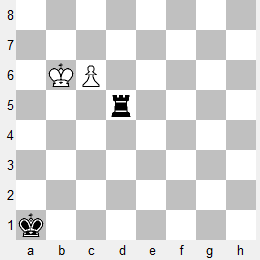
This is the famous position. It was initially published in an 1895 chess column with the solution

1.c7 Rd6+ 2.Kb5 Rd5+ 3.Kb4 Rd4+ 4.Kb3 Rd3+ 5.Kc2 Rd4, followed by 6.c8=Q Rc4+ 7.Qxc4 stalemate.


Rev. Fernando Saavedra (1849-1922), a sharp-eyed reader of the column, pointed out that 6.c8=R Ra4 7.Kb3 wins, and the Saavedra position was born.

Mr. Rynd claimed that while the Rev. Saavedra was visiting Dublin he had seen his play and therefore Mr. Rynd should get credit for the discovery.

Mr. Roycroft being a fair historian states that Mr. Rynd's honesty should not be doubted unless further examples of his claims can be found. I cannot prove as yet that the last posts position was constructed however, it is a possibility and therefore does slightly tarnish the game. Mr. Roycroft also states that Mr. Rynd claimed to have won a match against Amos Burn although no prove of same can be found.

In all fairness there is also verifiable proof that Mr. Rynd was quite a strong player, winning the 1865 Irish Championship and with victories over W.H. Pollock, etc. But I think Mr. Roycrofts findings are spot on and detract from his other achievements.

Mr. Porterfield Rynd was quite opinionated and wasn't shy of controversy. As this clipping from the "Otago Witness" of 8th Sept 1892 shows.


Despite it all a very interesting character and one who will keep historians on their toes.

Monday, September 2, 2013

Forgotten Gem!

While doing some research recently I came across the following clipping. Hope you enjoy!

"CHESS FINESSE"


The end-game below occurred in actual play recently, and was first published by the Dublin Mail. It suggests the following remarks to the Times-Democrat :- "It must be confessed that it is not easy to define in limited or exact phraseology what is implied by the term 'finesse,' in chessplay. Perhaps as nearly correct as any definition would be that characteristic displayed in 'a move, or a series of moves, of such type as to induce (not compel) the adversary to play an answering move, or series of moves, apparently fortifying his position or increasing his attack, but, altogether, resulting in the development of a position which the finessing player is seeking to attain for a decisive coup.' But this is assuredly a long-winded, if precise definition, and needs some piquant illustration like the following position occurring in a game played a time time ago between Mr. Portefield Rynd, of Dublin, the leading Irish player, and Mr. Shepheard, of London.

BLACK, 8 (Mr. Shepheard).
 
WHITE, 10 (Mr. Rynd).

White having to play, the game proceeded :-


1.Re3 !
A beautifully subtle move, displaying chess finessing of high order. White seemingly plays here primarily to prevent Black's menaced perpetual check by Nb3 amd Nc1+, or to tempt Black into the incautious capture of the rook, which would be instantly fatal by 2.Qc7+, etc.
1...Rb6
But Black thinks he sees the scheme in the entirety, and, in turn, threatens one of his
own. He now menaces the safe capture of the rook after first playing Rxb5! Note bene, he is already the exchange ahead.
2.Qc7+ 
A possible check before, but then more brutum fulmen. Now, the first whisper of genuine thunder.
2...Ka8 
We wonder if Black heard it as he played?
3.Rd3 !! Resigns.
A thunderbolt itself! If  3...Rxd8 4.Qxc8#; if 3...Nxd3 Rxd8#; if 3...Qxd3 4.Bxd3 and wins easily; and finally, if 3...Qg5 4.hxg5 and wins still more easily. An elegant wind--up, and all the outcome of that one little, finessing move.

('The New Zealand Herald,' 19 March, 1892)

Saturday, August 27, 2011

Chess Puzzle

Sorry for the delay in posts - I was away on holiday's for two weeks and the Irish Chess Journal was my priority before that.


Came across the above position recently: White to play and win with a beautiful combination. 

Solution to last position:
Karpov - Taimanov
Leningrad, 1977
1...Ng3+!! 2.hxg3 Ra8! 0-1 
This game is justly famous for its brilliant Knight sacrifice, sometimes referred to as the "Taimanov" sacrifice, and the planned follow-up with the Rook. The final combination is indeed beautiful however, Karpov had blundered to reach the position.

Monday, July 25, 2011

Chess Puzzle

This week's position:


The above position is quite famous - so if it is familiar to some I am sorry. However, I think it's a brilliant position - Black to play and win.


Solution to last position:
Penrose - Jones
1979 British Championship
1.Qd8! Nb6 (1...Rxd8 2.cxd8+ Qxd8 3.Nc7+) 2.Ba5 the game ended 2...Bf6 3.Qxf8+ Qxf8 4.Bxb6 Qc8 5.Nc7+ 1-0

Friday, July 22, 2011

'Evening Echo', Tuesday, 26 April, 1994.

CCYMS bridge six-year gap

CCYMS bridged a six-year gap when they won Division One of the Munster Senior League for the first time since 1988 at Cahir the weekend before last.
In the closest finish for many years, the Young Men's side edged out Limerick A by the narrowest of margins. Douglas, holders of the title for the last five years and current All-Ireland Club champions, had to settle for third place.
Final standing: 1. CCYMS 41; 2. Limerick A 40.5; 3. Douglas 36.5; 4. Charleville 29; 5. Waterford 28.5; 6. Limerick B 19; 7. West Cork 15.5.
CCYMS took a 3.5 points lead over Limerick into the final round at Cahir where they faced Douglas. The Shannonsiders, meanwhile, were paired against tailenders West Cork. In an eventful finale, Limerick A duly dispatched their opponents 5-0, leaving CCYMS requiring at least two points for the title. This they achieved, despite going under 2-43 to the holders.
The victorious CCYMS team members in board order were Kieran Moynihan, Tadgh O'Leary, Finbarr Allison, Pat Twomey and Tom Myers.
CCYMS will now go on to represent Munster in the All-Ireland Club Championships.


West Cork are relegated to Division Two and Cork City A, winners of the second division title, are promoted.


-JIM OLNEY

Saturday, July 9, 2011

Missed opportunity at the Irish Championship

Today's clash between Colm Daly and Stephen Brady had to be one of the key games of the 2011 Irish Championship. So if you agree with that statement the following position has to be the key moment of the tournament.

Stephen after heroic efforts to win played 83...Bf6?? reaching the following position:


Colm replied 84.Ke?? and missed his chance. He could have drawn with 84.Na7 b4 85.Nc6 b3 86.Na5+ capturing the b-pawn next move and reaching a theoretically drawn position. As the bishop does not control the queening square and Black cannot force the White king out of the corner.

Weekly Puzzle:

This weeks puzzle:


Another nice position. It's White to play and win!

Solution to last puzzle:
Samisch, F - Schieferdecker
Mainz, 1953
1...Rdg8! 2.Kf1 Rg1+ 3.Kxg1 Qg8+ 4.Kf1 (4.Kh1 Qg2#) 4...Qc4+ 5.Kg1 Rg8+ 6.Kh1 Qf1#

Tuesday, June 28, 2011

'Evening Echo', Tuesday, 13th July, 1982

Two Corkmen In The Irish Team

TWO Cork players are included in the Irish men's squad selected last week to compete in the 25th biennial Chess Olympiad which will take place in Lucerne from October 30 to November 16, 1982. Anthony McCarthy, who made his Olympiad debut in Malta in 1980, retains his place, while Irish co-champion Philip Short, currently defending his title at the IBM Irish Championship in the City Hall, Cork, comes in for his first taste of World Team Championship competition.
The other members of the six-man squad are Dubliners David Dunne, Tony Doyle, Eugene Curtin and John Delaney. Like McCarthy - Dunne, Doyle and Curtin also played in Malta where Ireland attained its best-ever Olympiad result when finishing in joint 38th place out of 84 competing nations. Gone from that side - are former Irish champion Paul Delaney, who is taking a break from the game, and the Liverpool-based national master Alan Ludgate.

McCarthy achieved the best percentage score on the Irish team in Malta. His 5/8 total comprised four wins, two draws and two losses, and included his first-ever victory over an international master, the Portuguese player Durao. The other Irish individual scores were: Paul Delaney 5/11, David Dunne 5/10, Tony Doyle 3.5/8, Alan Ludgate 5/10 and Eugene Curtin 5/9.
Ireland's Olympiad record over the past decade or so reads: 42nd from 60 entries at Siegan in 1970; 40th from 63 entries at Skopje in 1972; 37th from 74 entries at Nice in 1974; 34th from 48 entries at Haifa in 1976; did not compete at Buenos Aires in 1978; 38th from 84 entries at Malta in 1980.
The current side contains a nice blend of youth and experience and will be hoping to continue the gradual improvement shown by their predecessors when they gather in Lucerne in October.
The 10th running of the women's Olympiad will be staged alongside the men's event in Lucerne. The Dublin-based Irish side is April Cronin, Ann Delaney, Suzanne Connolly and Gay Martin. The reserves are mother and daughter Dorren and Maura Ni Siochru.
Twenty-two-year-old David Dunne, national co-champion with Short, is also defending his title at the City Hall in a field that also includes internationals John Delaney, Colm Barry, Keith Allen and thrice national title-holder Alan Ludgate.
The overall entry is below one hundred and is slightly down on the 1980 numbers when the championship was last held in Cork. The support from local competitors has been excellent, but entries from outside the Cork area have been most disappointing.
However, the lucrative four-figure prize fund on offer for the weekend South of Ireland Open Championship should attract a large field and help swell the overall numbers to more satisfactory proportions.
The six-round 'South' Open will commence on Friday next, July 16 at 7.15 p.m. Three rounds will be played on Saturday at 9 a.m., 2 p.m. and 7 p.m., with the final two rounds on Sunday beginning at 9.30 a.m. and 2 p.m.
Entries (£8) should reach the controller John Quigley, "Cluain Mhuire", Trabeg Lawn, South Douglas Road, Cork. Tel. 291903, by Thursday next. However, in the event of vacancies, late entries will be accepted up to the commencement of play on Friday night.
-JIM OLNEY
 
Just because I can - I'll give the above-mentioned game:
 

Interesting to see Joaquim Durao pop up again he has had a long and varied association with Irish chess.


Wednesday, June 15, 2011

Weekly puzzle:

This week's puzzle:


I like this position. As you may have noticed White threatens mate on a8 and it seems that Black can't avoid it. However, it is Black to play and win!


Solution to last puzzle:
Dolgisch - Gilesetdinov
USSR, 1978
1.Rg7! Bxg7 2.f7+ Kh8 3.Re8#

Friday, June 10, 2011

Evening Echo, Tuesday, 25 June, 1991

ULSTER won the 1991 Interprovincial Championships held recently in Kill, Co. Kildare.
The Northerners scored a narrow 5.5-4.5 win over Munster in the semi-finals and, although held to a 5-5 draw by Leinster in the decider, they were awarded the title on board count.
In their second match, Munster scored an emphatic 8.5-1.5 victory over a combined Irish Junior Chess Association/Leinster B team.
The Munster team comprised Philip Short, Mel Kennedy, Kieran Moynihan, Colm Quigley, Kevin James, Kevin O'Shea, Ken Salmon, Frank Noonan, Paul Kiely and John Mee.
Much of the credit for Ulster's victory goes to 13-year-old Derry schoolboy Adrian Gillen who held Philip Short to a draw and defeated Leinster's international Colm Barry from a level position.
Here are two Munster wins:


As always by Jim Olney.

As a footnote: 
It was great to hear from Kevin O'Shea today who gave me the following info on the above event. "Two quick asides: I arranged a mini-bus for the mostly Cork based players that day. It broke down a number of times on the way home, always outside pubs, and to this day all the players believe it was coincidence!!? Also being quite pedantic Noel Mulholland's 23rd move was 23...Be8.

Thursday, June 2, 2011

Chess Puzzle

Today's puzzle:


Another position which shouldn't be too taxing!? White to play and win.

Solution to last puzzle:
Quinteros - Sunye
San Pedro 1981
1.Rxf8! (if 1...Rxf8 2.Nd6+ wins) if 1...Kxf8 2.Rd8+ Ke7 3.Qxg5+! wins) 1-0

Friday, May 27, 2011

Cork Examiner, Tuesday, July 14, 1992

Today I'm going to begin a new feature - I'm going to present some of my press cuttings. These are by Jim Olney who has written his column for thirty years. I'll begin with an international flavour - I'll leave my prejudices for the next issue.


COLM DALY emerged as Ireland's top points earner at the recent Olympiad in Manila. The 24-year-old Leinster champion totalled 5.5/11 to register a 50% score on board two.
National title-holder Stephen Brady also achieved a 50% score with 5/10, as did Tom Clarke with 4/8.
The other individual performances were: IM Mark Orr 3.5/10 on board one, Kilian Hynes 3.5/9 and Joe Ryan 3.5/8.
The Irish side finished a disappointing 82nd in the 112 nation field with 25/56.
Individual highlights were Orr's draw with Icelandic grandmaster Margeir Petursson and some highly creative play from Daly in the following game against a 2520-rated IM:


Hope you enjoy!

Wednesday, May 25, 2011

Chess Puzzle

 Today's puzzle:


Nothing to complicated this time, it's just White to play and win.

Solution to last puzzle:
Tal - Bilek
Miskolc 1963
1.Rxf6 Rxf6 2.Qxe5 axb3 3.axb3
This is the really beautiful move behind the combination. White is a rook down but the pin against f6 is so powerful that there is no need to rush.
3...b6 4. b4
Preventing 4...Ra5, which would complicate matters. Now there is no stopping 5.Rf1 so Black resigned.

Wednesday, January 5, 2011

Hastings Congress 2010-11 Update

Sorry to say Ryan Griffiths didn't make the International masters norm this time. It was a lot to expect - a win with black against an International master in the final round.
However, it's just a matter of time and I definitely think this year Ryan will achieve at least one norm result.

Still a good performance at the Hastings tournament - well done Ryan on a good scalp and keep up the great work. Your making us proud.

Monday, January 3, 2011

Hastings Congress 2010-11 Update

Ryan Rhys Griffiths had a good day today winning a lovely game against Australian International Master Alexsandar Wohl. It was a great game to watch as Wohl realized his position was lost from very early on. He tried to complicate the game but Ryan had it all under control and the win was never in doubt.  So Ryan has 5 points after seven rounds and should have a difficult pairing in the next round.


In my opinion Black is winning from as early as move nine - what do you think?

Sunday, January 2, 2011

Hastings Masters 2010-2011

It's good to see Ryan Rhys Griffiths having a nice run in the 2010-2011 Hastings Masters. After six rounds he has four points. Losing only one game: in the first round to GM Kotronias (2591). Below I give today's round (6) game in which he holds Valerly Neverov (2522) to a draw.

Nice one Ryan!! Anyone interested in the Hastings Masters or in Ryan Rhys Griffiths progress should keep an eye on the Hastings Congress site here.

Wednesday, October 20, 2010

Chess Puzzle

Today's puzzle is a beauty!


Black's must have been happy with his last move: 24...a4. However, White's next move shattered any illusions he may have had. White to play and win.

Solution to the last puzzle:
Bogoljubow- Ed. Lasker
New York 1924
1.Bxg5 Kxg5 2.d5 Kf6 3.d7 Bxd7 4.exd7 Ke7 5.Kc5 a6 6.Kb6 1-0

Thursday, October 14, 2010

Chess Puzzle

Today's puzzle:


Opposite coloured bishop endings have a frustrating tendency to end in a draw. White could play 1.Kc5, but is there a way to bring about a speedier conclusion?

Solution to last puzzle:
Roneat - Reicher
Germany 1950
1.Qe6+ Black is obliged to capture the queen by 1...Nxe6 or 1...Bxe6. Either way it makes no difference; White plays 2.Nh6#. Note that e6 was the only good square on which to give up the queen; anywhere else would have broken the mating net around the black king.