Wednesday, September 18, 2013

Mr. Rynd the Arch Deceiver?


I am sorry to say that after further research I have stumbled upon an article by John Roycroft in EG143 that sheds serious doubt on the honesty of our Mr. Porterfield Rynd. It appears Mr. Rynd in one of his columns laid claim to having played the variation that later became famous as the Saavedra position.
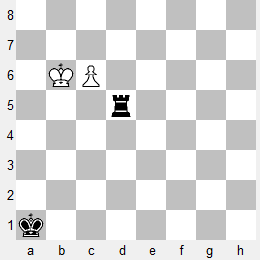
This is the famous position. It was initially published in an 1895 chess column with the solution

1.c7 Rd6+ 2.Kb5 Rd5+ 3.Kb4 Rd4+ 4.Kb3 Rd3+ 5.Kc2 Rd4, followed by 6.c8=Q Rc4+ 7.Qxc4 stalemate.


Rev. Fernando Saavedra (1849-1922), a sharp-eyed reader of the column, pointed out that 6.c8=R Ra4 7.Kb3 wins, and the Saavedra position was born.

Mr. Rynd claimed that while the Rev. Saavedra was visiting Dublin he had seen his play and therefore Mr. Rynd should get credit for the discovery.

Mr. Roycroft being a fair historian states that Mr. Rynd's honesty should not be doubted unless further examples of his claims can be found. I cannot prove as yet that the last posts position was constructed however, it is a possibility and therefore does slightly tarnish the game. Mr. Roycroft also states that Mr. Rynd claimed to have won a match against Amos Burn although no prove of same can be found.

In all fairness there is also verifiable proof that Mr. Rynd was quite a strong player, winning the 1865 Irish Championship and with victories over W.H. Pollock, etc. But I think Mr. Roycrofts findings are spot on and detract from his other achievements.

Mr. Porterfield Rynd was quite opinionated and wasn't shy of controversy. As this clipping from the "Otago Witness" of 8th Sept 1892 shows.


Despite it all a very interesting character and one who will keep historians on their toes.

Monday, September 2, 2013

Forgotten Gem!

While doing some research recently I came across the following clipping. Hope you enjoy!

"CHESS FINESSE"


The end-game below occurred in actual play recently, and was first published by the Dublin Mail. It suggests the following remarks to the Times-Democrat :- "It must be confessed that it is not easy to define in limited or exact phraseology what is implied by the term 'finesse,' in chessplay. Perhaps as nearly correct as any definition would be that characteristic displayed in 'a move, or a series of moves, of such type as to induce (not compel) the adversary to play an answering move, or series of moves, apparently fortifying his position or increasing his attack, but, altogether, resulting in the development of a position which the finessing player is seeking to attain for a decisive coup.' But this is assuredly a long-winded, if precise definition, and needs some piquant illustration like the following position occurring in a game played a time time ago between Mr. Portefield Rynd, of Dublin, the leading Irish player, and Mr. Shepheard, of London.

BLACK, 8 (Mr. Shepheard).
 
WHITE, 10 (Mr. Rynd).

White having to play, the game proceeded :-


1.Re3 !
A beautifully subtle move, displaying chess finessing of high order. White seemingly plays here primarily to prevent Black's menaced perpetual check by Nb3 amd Nc1+, or to tempt Black into the incautious capture of the rook, which would be instantly fatal by 2.Qc7+, etc.
1...Rb6
But Black thinks he sees the scheme in the entirety, and, in turn, threatens one of his
own. He now menaces the safe capture of the rook after first playing Rxb5! Note bene, he is already the exchange ahead.
2.Qc7+ 
A possible check before, but then more brutum fulmen. Now, the first whisper of genuine thunder.
2...Ka8 
We wonder if Black heard it as he played?
3.Rd3 !! Resigns.
A thunderbolt itself! If  3...Rxd8 4.Qxc8#; if 3...Nxd3 Rxd8#; if 3...Qxd3 4.Bxd3 and wins easily; and finally, if 3...Qg5 4.hxg5 and wins still more easily. An elegant wind--up, and all the outcome of that one little, finessing move.

('The New Zealand Herald,' 19 March, 1892)

Saturday, August 27, 2011

Chess Puzzle

Sorry for the delay in posts - I was away on holiday's for two weeks and the Irish Chess Journal was my priority before that.


Came across the above position recently: White to play and win with a beautiful combination. 

Solution to last position:
Karpov - Taimanov
Leningrad, 1977
1...Ng3+!! 2.hxg3 Ra8! 0-1 
This game is justly famous for its brilliant Knight sacrifice, sometimes referred to as the "Taimanov" sacrifice, and the planned follow-up with the Rook. The final combination is indeed beautiful however, Karpov had blundered to reach the position.

Monday, July 25, 2011

Chess Puzzle

This week's position:


The above position is quite famous - so if it is familiar to some I am sorry. However, I think it's a brilliant position - Black to play and win.


Solution to last position:
Penrose - Jones
1979 British Championship
1.Qd8! Nb6 (1...Rxd8 2.cxd8+ Qxd8 3.Nc7+) 2.Ba5 the game ended 2...Bf6 3.Qxf8+ Qxf8 4.Bxb6 Qc8 5.Nc7+ 1-0

Friday, July 22, 2011

'Evening Echo', Tuesday, 26 April, 1994.

CCYMS bridge six-year gap

CCYMS bridged a six-year gap when they won Division One of the Munster Senior League for the first time since 1988 at Cahir the weekend before last.
In the closest finish for many years, the Young Men's side edged out Limerick A by the narrowest of margins. Douglas, holders of the title for the last five years and current All-Ireland Club champions, had to settle for third place.
Final standing: 1. CCYMS 41; 2. Limerick A 40.5; 3. Douglas 36.5; 4. Charleville 29; 5. Waterford 28.5; 6. Limerick B 19; 7. West Cork 15.5.
CCYMS took a 3.5 points lead over Limerick into the final round at Cahir where they faced Douglas. The Shannonsiders, meanwhile, were paired against tailenders West Cork. In an eventful finale, Limerick A duly dispatched their opponents 5-0, leaving CCYMS requiring at least two points for the title. This they achieved, despite going under 2-43 to the holders.
The victorious CCYMS team members in board order were Kieran Moynihan, Tadgh O'Leary, Finbarr Allison, Pat Twomey and Tom Myers.
CCYMS will now go on to represent Munster in the All-Ireland Club Championships.


West Cork are relegated to Division Two and Cork City A, winners of the second division title, are promoted.


-JIM OLNEY

Saturday, July 9, 2011

Missed opportunity at the Irish Championship

Today's clash between Colm Daly and Stephen Brady had to be one of the key games of the 2011 Irish Championship. So if you agree with that statement the following position has to be the key moment of the tournament.

Stephen after heroic efforts to win played 83...Bf6?? reaching the following position:


Colm replied 84.Ke?? and missed his chance. He could have drawn with 84.Na7 b4 85.Nc6 b3 86.Na5+ capturing the b-pawn next move and reaching a theoretically drawn position. As the bishop does not control the queening square and Black cannot force the White king out of the corner.

Weekly Puzzle:

This weeks puzzle:


Another nice position. It's White to play and win!

Solution to last puzzle:
Samisch, F - Schieferdecker
Mainz, 1953
1...Rdg8! 2.Kf1 Rg1+ 3.Kxg1 Qg8+ 4.Kf1 (4.Kh1 Qg2#) 4...Qc4+ 5.Kg1 Rg8+ 6.Kh1 Qf1#